
Geometry Dash vs Jewel Quest: Action or Puzzle Adventure?
Geometry Dash and Jewel Quest are two games built around completely different types of challenges. Geometry Dash is a rhythm-based action platformer where players avoid obstacles through precise timing. Jewel Quest is a match-3 puzzle game where players swap jewels, create combinations, and turn the game board into gold.
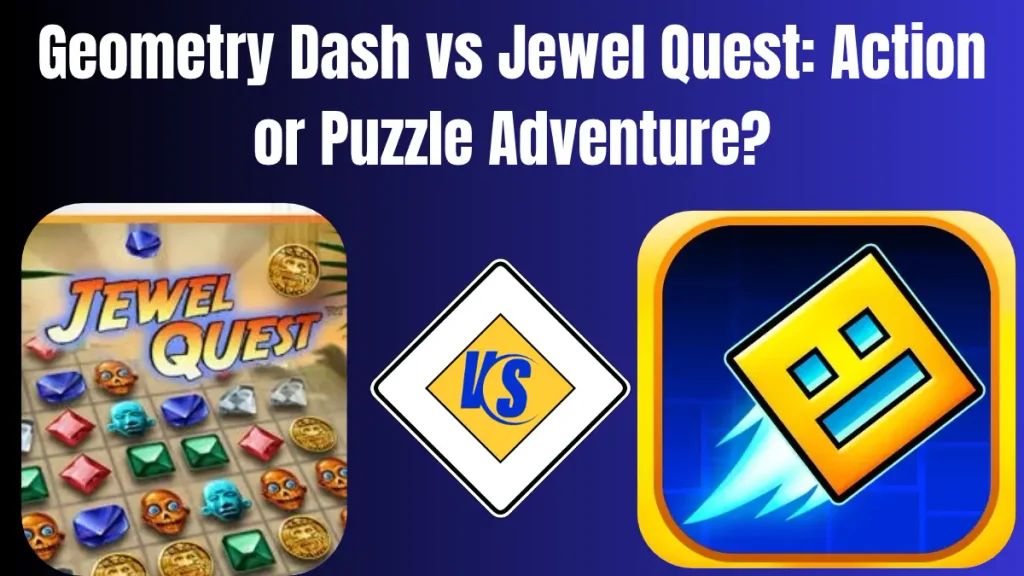
Both games are easy to understand at first, but they require different skills to master. Geometry Dash tests reflexes and coordination, while Jewel Quest focuses on planning and pattern recognition. Here’s how they compare in gameplay, difficulty, progression, visuals, and replay value.
Geometry Dash vs Jewel Quest: Quick Comparison
| Feature | Geometry Dash | Jewel Quest |
|---|---|---|
| Developer | RobTop Games | iWin |
| Genre | Rhythm-based action platformer | Match-3 puzzle |
| Original release | 2013 | 2004 |
| Main objective | Complete levels and avoid obstacles | Match jewels and turn board spaces gold |
| Controls | Timed taps and presses | Swap adjacent jewels |
| Main challenge | Reflexes and timing | Strategy and pattern recognition |
| Music | Rhythm-focused soundtracks | Puzzle background music |
| Progression | Official and user-created levels | 180 levels in the original game |
| Customization | Icons and colors | No comparable character customization |
| Level creation | Built-in level editor | No built-in level editor |
Gameplay: Platforming vs Match-3 Puzzles
The biggest difference between Geometry Dash and Jewel Quest is their core gameplay.
Geometry Dash puts players in control of a character that moves through levels filled with spikes, gaps, and other obstacles. Players must jump, fly, and change movement patterns at the right moment to reach the end. The music often helps establish the rhythm of the action, but successful runs still require accurate timing and concentration.
Jewel Quest uses a completely different approach. Players swap adjacent jewels to create horizontal or vertical matches of three or more identical pieces. Each successful match turns the spaces underneath the jewels into gold. The objective is to turn the entire board gold before time runs out.
Controls and Learning Curve
Geometry Dash has simple controls. In its traditional gameplay, players tap or press a button to make the character jump or perform other actions. The controls are easy to understand, but completing difficult levels requires practice and accurate timing.
Jewel Quest uses straightforward swapping controls. Players select two neighboring jewels and exchange their positions to create a valid match. The basic mechanic is easy to learn, although later boards require more careful decisions.
Difficulty and Challenges
Geometry Dash can become extremely challenging. Some levels contain tightly placed obstacles, fast movement changes, and sections that require repeated attempts. A single mistake can end a run, so players often need to memorize patterns and improve their timing.
Jewel Quest becomes harder by introducing more complicated board layouts and puzzle situations. Players must complete the gold-board objective while working against a time limit. Certain spaces can be difficult to reach, making it important to think ahead rather than make random matches.
Levels and Progression
Geometry Dash offers official levels with different music, obstacles, and difficulty ratings. Players can use Practice Mode to learn difficult sections. The full game also includes a level editor, allowing players to create and share their own challenges.
The original Jewel Quest follows a structured puzzle progression. It contains 36 board layouts that are played through five times, with each round introducing greater difficulty. This creates a total of 180 levels. Players gradually face more complicated boards as they advance.
Music, Graphics, and Visual Style
Geometry Dash uses colorful geometric visuals, bright effects, and fast-moving backgrounds. Its music is an important part of the experience because the rhythm often connects with the movement and obstacle patterns. Different soundtracks help give levels their own identity.
Jewel Quest has a treasure-hunting theme inspired by ancient Mayan settings. Its boards feature jewels, coins, relics, and other decorative pieces. The visual design supports the puzzle experience rather than creating a fast-paced action environment.
Customization and Replay Value
Geometry Dash offers several customization options. Players can unlock different icons and colors, earn achievements, and change how their character looks. Its level editor is especially important because players can build and share new levels with the community.
The original Jewel Quest does not offer the same type of character customization or level creation. Its replay value comes from completing puzzle boards, improving scores, and revisiting earlier challenges.
Which Game Is More Relaxing?
Jewel Quest may feel more relaxing for players who enjoy thinking through moves instead of reacting to obstacles. Its match-3 gameplay gives players time to study the board and look for useful combinations, although the original game does include time limits.
Geometry Dash is generally more demanding during active gameplay. Players must pay attention to obstacles, movement changes, and timing. Difficult levels can require repeated attempts, which may feel intense rather than relaxing.
Which Game Should You Play?
Choose Geometry Dash if you enjoy:
- Fast-paced platforming and obstacle challenges.
- Music-based gameplay and precise timing.
- Difficult levels that reward practice.
- Unlocking icons and customizing your character.
- Creating and playing community-made levels.
Choose Jewel Quest if you enjoy:
- Matching jewels and solving puzzles.
- Planning moves before making them.
- Completing boards with clear objectives.
- Treasure-hunting themes and colorful puzzle layouts.
- A more strategy-focused gaming experience.
Both games offer enjoyable challenges, but they appeal to different types of players.
Final Verdict
Geometry Dash vs Jewel Quest is a comparison between action-based platforming and classic match-3 puzzles. Geometry Dash is the stronger choice for players who enjoy rhythm, quick reactions, precise movement, and challenging levels. Its level editor and community content also provide plenty of variety.
Jewel Quest is better suited to players who prefer matching jewels, recognizing patterns, and completing puzzle objectives. Its gold-board mechanic gives the familiar match-3 formula an additional strategic goal.