Geometry Dash vs A Dance of Fire and Ice: Key Differences
Geometry Dash and A Dance of Fire and Ice (ADOFAI) are two popular rhythm games that challenge players to follow music and maintain precise timing. However, they offer very different gameplay experiences. If you enjoy rhythm-based challenges, Geometry Dash and ADOFAI represent two unique philosophies.
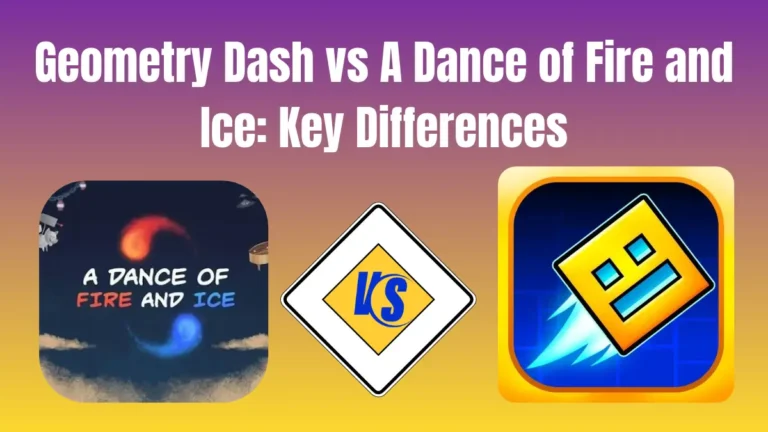
Geometry Dash combines platforming, obstacles, and music, while ADOFAI focuses on pressing a button in time with rhythmic patterns. Let’s compare their gameplay, controls, difficulty, music, and features.
What Is Geometry Dash?
Geometry Dash is a rhythm-based platformer developed by RobTop Games. Players control a geometric character that moves through levels filled with spikes, obstacles, gaps, and other challenges.
The main goal is to reach the end of each level without crashing. Players must time their jumps and movements while following the soundtrack.
Its main features include:
- Gameplay Modes: Multiple modes including Cube, Ship, Ball, and Wave.
- Challenging Levels: Official rhythm-based stages designed to test timing and reflexes.
- Practice Mode: A checkpoint system for practicing difficult sections.
- Customization Options: Unlockable icons and color schemes for player characters.
- Level Editor: Comprehensive creative tools for creating and sharing custom levels.
Geometry Dash combines music, reflexes, and platforming into one challenging experience.
What Is A Dance of Fire and Ice?
A Dance of Fire and Ice is a one-button rhythm game developed by 7th Beat Games. Instead of controlling a character through obstacles, players guide two orbiting planets along a winding path.
You press a button on every beat to move the planets forward. Each level introduces different rhythmic patterns, requiring accurate timing and concentration.
Its main features include:
- Simple One-Button Controls: Accessible single-input mechanics.
- Rhythmic Patterns: Varied musical patterns and timing challenges.
- Visual Design: Colorful worlds and dynamic camera effects.
- Custom Level Creation: Built-in level creator for building custom tracks.
- Steam Workshop Support: Easy sharing and discovering of community-made levels.
Unlike traditional platformers, ADOFAI focuses almost entirely on rhythm recognition and timing.
Geometry Dash vs A Dance of Fire and Ice: Main Differences
1. Gameplay
Geometry Dash focuses on platforming. Players jump, fly, and navigate obstacles while progressing through levels.
ADOFAI uses a different approach. Players guide two planets along a path by pressing in time with the music. Every movement follows a specific rhythmic pattern.
2. Controls
Geometry Dash uses simple controls, such as tapping, clicking, or pressing a keyboard key. However, different gameplay modes require different timing and movement skills.
ADOFAI uses a single input. Players press one button on every beat, making the controls simple but demanding precise timing.
3. Difficulty
Both games can become extremely challenging, but they test different skills.
Geometry Dash requires quick reactions, memorization, and accurate movement. ADOFAI requires rhythm recognition, concentration, and consistent timing.
Which one feels harder depends on your strengths and experience with rhythm games.
4. Music and Soundtracks
Music plays an important role in both games.
In Geometry Dash, soundtracks accompany the platforming and help players follow the level’s rhythm.
In ADOFAI, music directly controls the gameplay. Players must listen carefully because every beat determines when to press the button.
5. Levels and Customization
Geometry Dash offers official levels and a large collection of user-created levels. Its full version also includes an editor that allows players to design and share their own stages.
ADOFAI also supports custom levels through its level editor and community sharing features. Steam players can use the Workshop to discover additional challenges.
Geometry Dash vs ADOFAI: Comparison Table
| Feature | Geometry Dash | A Dance of Fire and Ice |
|---|---|---|
| Developer | RobTop Games | 7th Beat Games |
| Genre | Rhythm platformer | Rhythm game |
| Main gameplay | Avoid obstacles | Follow rhythmic paths |
| Characters | Geometric icons | Two orbiting planets |
| Controls | Tap, click, or key | One-button input |
| Main challenge | Reflexes and timing | Rhythm and precision |
| Music | Supports platforming | Drives every movement |
| Custom levels | Yes | Yes |
| Level editor | Yes | Yes |
| Practice | Practice Mode | Rhythm learning and calibration |
Which Game Is More Difficult?
There is no universal answer because both games challenge players in different ways.
Geometry Dash can be difficult because of fast-moving obstacles, tight jumps, and complicated level designs. Players need strong reflexes and must memorize challenging sections.
ADOFAI becomes difficult when rhythmic patterns become faster or more complex. Even a small timing mistake can interrupt progress.
If you are good at platforming and quick reactions, Geometry Dash may feel more natural. If you have a strong sense of rhythm, ADOFAI may be easier to understand.
Which Game Should You Play?
Choose Geometry Dash if you:
- Enjoy platforming and obstacle challenges.
- Like different gameplay modes and movement variety.
- Want to create and play custom levels.
- Prefer a combination of music and fast reactions.
Choose A Dance of Fire and Ice if you:
- Enjoy rhythm-focused gameplay.
- Prefer simple one-button controls.
- Like learning complex musical patterns.
- Want challenges based purely on timing and precision.
Both games offer rewarding experiences, so your choice depends on the type of challenge you enjoy.
Final Wording
Geometry Dash and A Dance of Fire and Ice are both challenging rhythm games, but they approach music-based gameplay differently.
Geometry Dash combines platforming, obstacles, and reflexes, while ADOFAI focuses on precise musical timing through one-button controls. Choose Geometry Dash for platforming challenges or ADOFAI for a more focused rhythm experience.